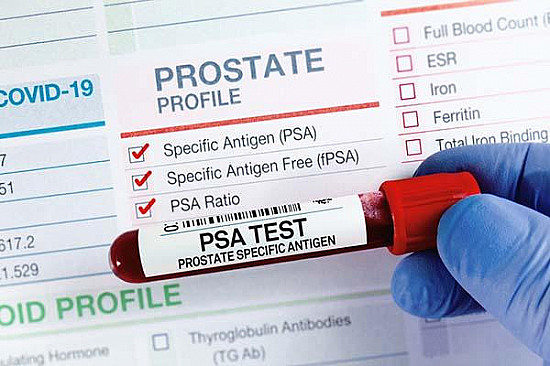









Prostate-specific antigen blood test (PSA test)
- Reviewed by Howard E. LeWine, MD, Chief Medical Editor, Harvard Health Publishing; Editorial Advisory Board Member, Harvard Health Publishing
What is the test?
The prostate-specific antigen blood test (PSA test) is a screening test. It measures the amount of prostate-specific antigen (PSA) in a man's blood.
PSA is a chemical made by the prostate. The prostate is a sex gland located near a man's bladder. It produces the fluid in semen. PSA levels normally increase as a man ages. But a higher-than-normal PSA level can be one clue that cancer has developed in the prostate gland.
However, high levels of PSA also can be found in other conditions that are noncancerous. These include prostatitis (inflammation of the prostate) and benign prostatic hyperplasia (BPH), an enlargement of the prostate that affects many older men.
|
|

What it's used for
A PSA test is used mainly as a screening test for cancer of the prostate. In men who have been diagnosed with prostate cancer, PSA is measured to determine if the cancer has returned after surgery. It can also be used to determine whether the cancer is growing or shrinking after treatment with hormones or radiation.
PSA testing can be used to detect the earliest stage of prostate cancer, before the disease causes any symptoms. However, an elevated PSA level often leads to overdiagnosis or finds low-grade cancer that would not affect how long a man lives or his quality of life.
A high PSA level may be caused by some other condition, such as a benign enlarged prostate or an inflamed prostate gland. Most prostate cancers diagnosed after PSA screening are localized cancers that have little potential to cause harm.
Many older men develop prostate cancer that never spreads and never causes any problems. Most of these harmless cancers would go undetected if screening was not done. In addition, treatment for prostate cancer can have serious side effects. Screening all men for prostate cancer and treating potentially harmless cancer might end up causing more harm than good.
In the past, most expert panels encouraged men to make an individual decision about whether or not to get periodic PSA blood testing.
Recently the American Cancer Society (ACS) updated their recommendations:
- For non-Black men at average risk of prostate cancer between the ages of 50 and 69, PSA testing every two years.
- For Black men and other men ages 45 to 69 with a family history of prostate cancer before age 65 or a family history of certain genetic mutations, PSA testing yearly.
- Men ages 70 to 74 should discuss the pros and cons of PSA testing with their doctor.
Rather than the American standard for determining a normal value of PSA at less than 4 ng/ml, ACS recommends using PSA less than 3 ng/ml for men ages 45 to 69 and PSA less than 6.5 ng/ml for men ages 70 to 74 when the blood test is done for prostate cancer screening.
In general, PSA testing is not recommended in men older than age 75 and men who have serious medical problems or other reasons for a limited life expectancy. This is because it may take a decade or more for prostate cancer to grow from the stage at which it can be first detected to the point where it causes symptoms or harm.
Preparation
Ejaculation can cause your PSA to rise briefly, so you should abstain from sexual activity for at least 48 hours before having your PSA level tested.
Blood for your PSA test probably will be taken from your arm. Wear a shirt or sweater with sleeves that roll up easily.
If you recently have had cystoscopy or needle biopsy of the prostate, let your doctor know so you can schedule your PSA test at another time. Those exams can raise PSA levels for a few weeks. This may make it harder to interpret the result of your PSA test.
PSA testing also should not be done until several weeks after you have been treated for a urinary tract infection.
How it's done
Blood for a PSA test usually is drawn from a vein in the crook of your elbow. The area from which blood will be taken will be cleaned with an alcohol swab. A sterile needle will be used to draw a few ounces of blood into a tube. The puncture site will be covered with a small gauze or bandage. Your blood sample will be sent to a lab where the PSA level is measured.
|
|

Follow-up
You should receive your PSA test result within one week after your blood was drawn. If you haven't, call your doctor's office. If your result is abnormal, your doctor may recommend additional diagnostic testing or repeating the blood PSA test later on. Alternatively, your doctor may refer you to a urologist for prostate biopsy.
Risks
Having your blood drawn is a simple procedure. There are few, if any, risks. However, when used as a screening test, PSA does have some risks. These include:
- a risk that your PSA test will be abnormal and that you will need to undergo further testing, such as a prostate biopsy. Keep in mind that as many as three-quarters of men with an elevated PSA level do not have prostate cancer. However, many men who are told that their PSA test is abnormal will have some anxiety until final results are available.
- a risk that screening will lead to treatment for prostate cancer that may or may not be necessary, but that may cause serious side effects
- A risk that your PSA level will be normal even if you do have prostate cancer.
Be sure to discuss these risks and the benefits of PSA testing with your doctor before you have your blood drawn.
When to call a professional
Call your doctor if blood continues to ooze from the needle puncture site. Also call if the site becomes red, swollen, or painful.
Additional info
American Cancer Society (ACS)
https://www.cancer.org/
National Cancer Institute (NCI)
https://www.nci.nih.gov/
About the Reviewer

Howard E. LeWine, MD, Chief Medical Editor, Harvard Health Publishing; Editorial Advisory Board Member, Harvard Health Publishing
Disclaimer:
As a service to our readers, Harvard Health Publishing provides access to our library of archived content. Please note the date of last review or update on all articles.
No content on this site, regardless of date, should ever be used as a substitute for direct medical advice from your doctor or other qualified clinician.