

Hip bursitis vs. arthritis: How to tell the difference

Fitness for longevity: Which type matters most?

Ministrokes linked to elevated risk of dementia

Continuous glucose monitors benefit people who don't need insulin

CoQ10: Should you take this popular supplement if you're on a statin?

Microplastics: A hidden health threat?

Oat vs. dairy milk: Nutrition, benefits, and downsides

What is tempeh? Benefits, nutrition, and how to use it

Healing after food poisoning

Whole grains may improve several heart risk factors at once
Breast Cancer Archive
Articles

10 tips for finding the right shoes
When shopping for shoes, you want to have more than fashion in mind — you'll also want to consider function and keeping your feet in good shape. These 10 tips can help you choose the right shoes:
- Take a tracing of your foot with you. Place any shoe you think you might buy on top of the tracing. If the shoe is narrower or shorter than the tracing, don't even try it on.
- Shop for shoes during the afternoon — your foot naturally expands with use during the day.
- Wear the same type of socks to the store that you intend to wear with the shoes.
- Have a salesperson measure both of your feet — and get measured every time you buy new shoes. Feet change with age, often growing larger and wider. If one foot is larger than the other, buy a size that fits the larger foot.
- Stand in the shoes. Press gently on the top of the shoe to make sure you have about a half-inch of space between your longest toe and the end of the shoe. This provides enough room for your foot to press forward as you walk. Wiggle your toes to make sure there's enough room.
- Walk around in the shoes to determine how they feel. Is there enough room at the balls of the feet? Do the heels fit snugly, or do they pinch or slip off? Don't rationalize that the shoes just need to be "broken in." Find shoes that fit from the start.
- Trust your own comfort level rather than a shoe's size or description. Sizes vary between manufacturers. And no matter how comfortable an advertisement claims those shoes are, you're the real judge.
- Pay attention to width as well as length. If the ball of your foot feels compressed in a particular shoe, ask if it comes in a wider size. Buying shoes that are a half-size bigger — but not any wider — won't necessarily solve the problem.
- Feel the inside of the shoes to see if they have any tags, seams, or other material that might irritate your foot.
- Examine the soles. Are they sturdy enough to provide protection from sharp objects? Do they provide any cushioning? Take note of how they feel as you walk around the shoe store. Try to walk on hard surfaces as well as carpet to see how the shoe feels on both.
For more advice on keeping your feet pain-free, buy Healthy Feet, a Special Health Report from Harvard Medical School.
Ask the doctor: Prostate surgery and ED
Q. I am scheduled to have my prostate removed and am concerned about the risk of erectile dysfunction (ED) after the surgery. I've heard that taking an ED drug daily during my recovery could help. Do you recommend this?
A. About half of men lose some erectile function after radical prostatectomy, which removes the entire prostate gland. ED drugs help men to have erections after surgery, but so far research has not shown that taking it daily produces better results than taking the medication as-needed—when you anticipate sexual activity.
Both work and parenting influence risk of early death
The health effects of balancing career and parenting have been studied a lot, but most of the attention has focused on a single period in the middle of a woman's life. Recently, researchers affiliated with Harvard University and the Harvard T.H. Chan School of Public Health decided to look at how sustaining that balancing act over decades affects a woman's risk of dying before age 75.
The team studied data on work histories, marriages, and parenting for more than 7,500 women in the U.S. Health and Retirement Study—an ongoing biennial survey of the health and lifestyles of thousands of women and men. They found that a woman's risk of dying between ages 55 and 75 varied substantially with her history of work, marriage, and childrearing. Married women who went back to work after staying at home with their children had the lowest death rate—around 5%—while single mothers who had never worked had the highest rate—12%. The death rate was just under 7% for nonworking married mothers, and slightly above 8% for single working mothers. The report appeared in the April 2015 issue of the American Journal of Public Health.

Draft recommendations on screening mammography continue to stir debate
The release of new guidelines on mammography never fails to renew the heated controversy over the potential benefits and harms of this procedure. The latest draft guidelines from the U.S. Preventive Services Task Force (USPSTF) are no exception. The USPSTF recommends that women begin having mammograms at age 50 and stop at age 75. (The American Cancer Society and other medical organizations recommend that women begin getting regular mammograms at age 40.) The draft recommendations say there isn’t enough evidence to recommend or discourage the use of a new technique called 3-D mammography for screening, and also say there isn’t enough evidence to recommend that women with dense breasts, who are at higher risk of breast cancer, should have an ultrasound or MRI in addition to screening mammography. Comments can be made on the USPSTF draft until 8:00 pm Easter Time today. A final version of the recommendations is expected to be released in the fall of 2015.
Cardiovascular consequences of hormone therapy
A large study reinforces the current thinking on hormone therapy after menopause: it doesn't shield women from heart disease and may slightly increase their risk of a stroke.
For decades, doctors believed that hormone therapy could prevent heart disease. But in 2002, findings from the landmark Women's Health Initiative revealed that long-term hormone use boosted heart attack, stroke, and breast cancer risk.

Switching to a fiber-rich diet may lower colon cancer risk in blacks
Switching from a “Western” diet with lots of fat and meat to a fiber-rich diet for just two weeks makes conditions in the large intestine less favorable to the development of colon cancer. The opposite switch may promote the formation of cancer. That’s the conclusion from a small but elegant study done in urban Pittsburgh and rural KwaZulu-Natal, South Africa. In the study, 20 volunteers from each area switched diets. For two weeks, the Americans ate a traditional high-fiber African diet rich in fruits, vegetables, nuts, and beans, while the Africans ate a Western diet with more fat, protein, and meat. In just two weeks, significant changes occurred in the lining of the colon and in its chemical and bacterial make-up in both groups, but in different directions. Those following the African diet showed improvements in colon health likely to protect against colon cancer, while those following the Western diet showed changes that could lead to colon cancer.
Hormone therapy works best when combined with radiation for locally advanced prostate cancer
Men with locally advanced prostate cancer who combine hormone therapy with a course of radiation therapy tend to live longer than men who only take hormone therapy.

No “best” treatment for common uterine fibroids
Fibroids are noncancerous tumors that grow in the uterus. They may be smaller than a seed or bigger than a grapefruit. Depending on their size, number, and location, fibroids can cause heavy bleeding and long menstrual periods (which can, in turn, cause anemia), pelvic pain, frequent urination, or constipation. Fibroids can also cause infertility and repeated miscarriages. About 7 in 10 women will develop this condition at some point. Given how common uterine fibroids are, it’s surprising how few randomized trials have been done to compare treatment options. A clinical practice article in today’s New England Journal of Medicine lays out the options for treating uterine fibroids and discusses the factors women and their doctors should consider when making treatment decisions.
Targeted prostate biopsies better at detecting dangerous cancers
Standard biopsies of the prostate gland often miss potentially aggressive prostate cancer. Adding MRI images to standard biopsies improves the detection of prostate cancer.
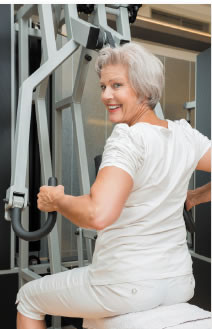
Are you really getting enough exercise?
Resistance machines can provide safe, effective strength training. Image: Thinkstock |
To get the full benefit of your workout, you need to know how hard you're exercising, and that can be different for everyone.
Hip bursitis vs. arthritis: How to tell the difference
Fitness for longevity: Which type matters most?
Ministrokes linked to elevated risk of dementia
Continuous glucose monitors benefit people who don't need insulin
CoQ10: Should you take this popular supplement if you're on a statin?
Microplastics: A hidden health threat?
Oat vs. dairy milk: Nutrition, benefits, and downsides
What is tempeh? Benefits, nutrition, and how to use it
Healing after food poisoning
Whole grains may improve several heart risk factors at once
Free Healthbeat Signup
Get the latest in health news delivered to your inbox!
Sign Up
